As far as my previous experience with art objects goes, I have very little. Most of my art object experience stems from my elementary and middle school art classes. Many of the assignments we were given, however, fell under the more “advanced” categories of pottery and sculpting. My art teachers generally tried to avoid delving us as students into abstract art. This is perhaps due to the fact that they felt that we would be unable to grasp the concept of it all. As a result, the majority of our art assignments involved everyday objects and still-life work. Generally, our created pieces were finished with glaze, so I do have some experience in that area as well when it comes to pottery. Although my past experience with art objects is rather limited, I feel that it will help me in many ways with this next writing project. For instance, in addition to creating sculptures in my art classes, we would also analyze and interpret works of art selected by our teacher. We would try to decipher our own meanings behind these works of art and often times create our own interpretations of them. I find this very helpful now even though the medium they would expose to us would be mainly paintings. This deciphering of the different meanings and emotions behind the works of art we would be assigned in class, and the analyzing and dissembling of such works has allowed me to more easily create in my mind both a visual picture and a verbal argument through which I would be able to interpret the work. Overall, I believe I would do well writing a rhetorical analysis on a sculpture I chose from the Sheldon Garden because of the experience I have had with art objects, but I am sure this will not stimulate me at all in the realm of creativity.
In hopes of breaking the tedium of reading and writing essays in the form of blog posts, I decided to choose the alternative option for this project and create my own comic. My comic is entitled “The Palovican Box of Love,” and it consists of seventeen panels. When working with the other students who opted for the alternative project, I quickly realized that my comic was much lengthier than theirs were. One was as short as three panels long, and the longest was no more than twelve. Rethinking the layout of my comic, and not wanting its length to be a disadvantage for me in its critique by my audience, I went back to my storyboard and looked to see if there were any panels I could edit or get rid of to compress my story and to possibly make it easier for the reader to understand. I was able to get rid of one panel completely and consolidate two others, but this resulted in the ironic addition of two new panels – panels 3 and 4. These two panels were added to visually illustrate where this family is headed and how greatly the image of this foreign country contrasts with the image of the “Big City” to which they have all grown accustomed.
Another aspect of “The Palovican Box of Love” that I incorporated in order to express the physical difference between the people of Palovica and the American family is the use of flowers. In this country I fabricated, flowers are found everywhere – on clothing and bedspreads, in picture frames, and in other decorations. Because of this, the viewer is easily able to distinguish the American teenager from his Palovican cousins, making it much easier to follow along with the story.
One characteristic I wanted my comic to have is relatability. I wanted my comic characters in the younger generation to be able to easily relate to the feelings and mindset of the people in my audience. In order to accomplish this task, I used simple and cartoon-like representations of people in my comic and dialogue and captioning that I have either used myself or heard before in conversations that have been within earshot range of me. In addition, I feel that the captions that have been placed on almost every panel contribute to this feeling of relatability. The audience is able to tune in to the inner thoughts of the American teen, who is the main character, and either agree or disagree with what he is saying. The use of captioning in this comic also works to further inform the reader. If he is not able to comprehend some aspect of the story, the unspoken comments of the teen help clarify.
I am pleased with the final layout of my comic and feel that all of the panels in “The Palovican Box of Love” are necessary and relevant to my story.
Rather than further analyze the comic I found on the web archive Pictures for Sad Children, and used in my last blog post, I decided to create my own for this next writing project. Never have I been interested in creating my own comics, but growing up around my father’s many comic books and his strong concernment with them I have developed some hidden fascination for them and the unique ways in which they tell stories. In addition, I have always been interested in drawing and sketching and, from the audience standpoint, enjoy engaging myself in the cartoons in the Sunday paper. Another reason I decided to create my own comic as opposed to selecting the first option for this assignment is I was ready for a change of pace in this course for myself and, to an extent, my fellow classmates and English professor. I hope to avoid the tedium that can be created by the usual readings and writings of English essays, and bring a little more creativity to this writing project.
The comic I have created is entitled “The Palovican Box of Love.” It is a humorous comic in which a spoiled teenage boy from New York City is going to a family reunion he does not really want to go to in a country called Palovica. He is acquainted with his grandmother, cousins, and other distant relatives he has not seen in years. Bored, the cousins decide to go surfing and “check out the ladies” down by the Palovican beach. There he sees a beautiful girl and decides to try and get her attention. Unfortunately, his American approaches to courtship are very unusual to the people of this country. The teenager finally decides to get some help from his native cousins to win over the Palovican beauty. They give the boy a box and tell him that this is the surefire way to get her attention. In the last frame, the audience discovers that her reception of the box did in fact win her over, and in the box was nothing more than a handful of cash.
My intention in creating this comic is to not only provide comic relief through this writing assignment, but to play on the idea that many people in America seem to think that all problems are able to be solved with money. I understand that my audience will need to distinguish between the Palovican-American family and the people native to Palovica to understand the underlying meaning of this comic, so I will make specific physical distinctions between the two in order to accomplish this. Furthermore, I will incorporate a fair amount of cultural context so that my audience will be fully able to understand the storyline. I think this incorporation of cultural context is even more important given the fact that Palovica is a country that as the author I fabricated. Through this unique manner in which my story is being told, I hope that my argument is realized and my audience find some humor in it.
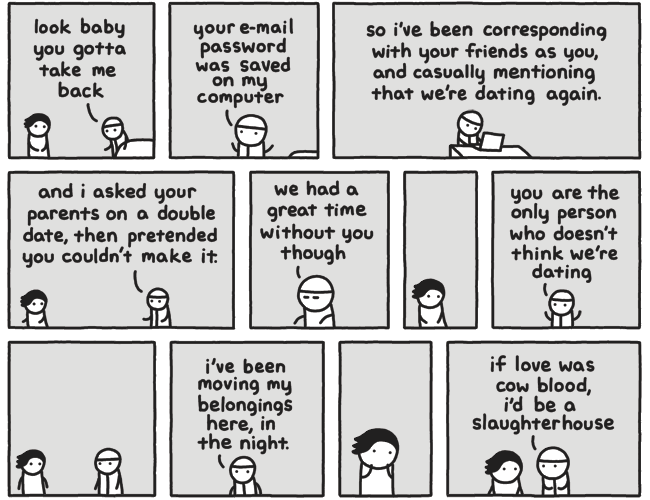
I found the above comic on the web comic archive Pictures for Sad Children. It is entitled Love and Guts and Bones, and was created by a man named John Campbell. Ironically, in contrast with the name of the archive, the humor found in many of the comics on this website is either dark or, frankly, strange. Some consist of violence while others consist of jokes that I would describe to be “corny.” There is a large variety in this archive, however, and all of these comics should be given at least one look-over.
The comic I chose, Love and Guts and Bones, consists of what seems to be an ex-boyfriend and an ex-girlfriend conversing with one another. The ex-boyfriend seems as if he is unable to let go of their past relationship, and is still telling his ex-girlfriend’s friends, family, and even email address contacts that they are in fact still together. He sounds a bit possessive in his communication, telling her, “You are the only person who doesn’t think we’re dating,” and ends the comic with, “If love was cow blood, I’d be a slaughterhouse.” He is trying to explain to her how much he cares for her, but the feeling is obviously not mutual. This fact is obvious even without the ex-girlfriend having to say anything. She says nothing throughout the whole comic, which adds to the ex-boyfriend’s characterization as possessive and maybe a little crazy. Visually, the relationship between the two characters is very distant. In the first panel, they are seen in pretty close proximity to each other, but it is obvious that the ex-girlfriend does not want to be around him. Her body language looks very tense, and she is calmly holding her hands in front of her body, closed off from her ex-boyfriend and not being at all visually receptive to what he is telling her. In the next panel she appears in, her body and arms are turned away from him; only her face turned to look in his direction. It almost appears as if she is trying to run or walk away from this young man. In two of the three panels following this one, she is alone. I think this gives us the effect of being able to understand her thoughts about the situation at hand without ever having to hear her speak. She is alone, but we still see her uncomfortable body language toward the young man.
I chose this comic because it has some of the elements that I am looking forward to incorporating into my own comic strip for this next writing project. This young boy has feelings for this young girl, but unfortunately, there is strong miscommunication between the two. He continues to speak to her and explain himself even when she is not communicating back to him in any verbal manner. This is a multi-paneled comic, and the relationship between the panels is established by a small break or separation between each. I like the aesthetic this gives off to the viewers. The comic becomes less confusing to read and seems to flow a little better with the breaks and separations between each panel. In the case of typography in Love and Blood and Guts, the typeface used is very simple. It is sans-serified and looks a bit childish. This effect further helps us to characterize the young man – since he is the only one speaking, and therefore being directly represented by the text.
In this first writing assignment, I chose a photograph from a specific selection of online photo galleries, and analyzed it in order to find the specific argument it conveys to its audience. In addition to uncovering the argument, we were asked to support it by expressing which photographic elements (i.e. coloration, cropping, framing, etc.) are used in its communication. Lastly, we sought out which rhetorical technique or techniques were used in the photograph to aid in the transmission of our argument to the audience. I found this particular assignment to be a more interesting extension of the work I had done in my high school English classes. We had many writing assignments, but they all consisted of analyzing literary works that were chosen respectively by my high school English teachers. These assignments became very tedious and frankly, boring, but they did assist me in my writing for this photograph analysis project.
Three drafts, including the following, were written – two of them edited by my peers – in hopes that the argument being presented in my writing came across effectively and was supported by real facts and research incorporated by myself. The background research of the photograph was included to introduce the context of the photo to the reader and set him or her up emotionally for the rest of the post. From my first draft to my final, not many dramatic changes were made. A few small changes were made, however, to improve the flow of my writing and strengthen the communication of my argument.
In the introductory paragraph, I reworded the first sentence to eliminate awkwardness and to open my post with a strong introduction. Specifically, I changed the second part of the sentence from, “more of which many of us would be able to bear” to, “more than most of us could bear,” when speaking of the violence and hatred the people of Rwanda have experienced. This small change makes the first sentence much less wordy and confusing and more to the point. In my second introductory paragraph, I wrote about the photo essay project given to the children of the Imbabazi Orphanage, but I did not mention the name of the project. I included its name, “Through the Eyes of Children,” in my writing in order to make it more real to my audience and give further background information. In my paragraph beginning, “Fishing by Twagira…,” I wrote heavily in the first person, speaking about my analysis of the photograph: “I have analyzed this photograph very similarly to the way in which I have analyzed literary works in the past,” but in my peer reviews and in my own rereading, I found that this use of first person narrative writing was not compatible with the style of analytical writing this assignment had me partake in. I rewrote this entire paragraph to give it a more professional aesthetic for my readers to experience, further strengthening my communication of the argument of the photo I selected. Lastly, in the paragraph analyzing the photo’s vectors of attention, I initially and mistakenly wrote about the effects of the horizon on the photograph, saying that in relation to the shoreline, it “pull[s] our eyes to the center.” I eliminated all mention of the function of the horizon, realizing that vectors of attention are only created by the figures in the photograph.
Overall, I am satisfied with the revisions I have made to create my final draft. It turned out quite well and effectively explains and support the argument I found within the photograph I selected.
The people of the republic of Rwanda, located in central Africa, have seen extreme hatred and violence; more than most of us could bear. Families and friends torn apart, homes destroyed, hundreds of thousands of lives stolen, the Rwandan Genocide greatly affected the lives of the people living in the small country. Beginning in April of the year 1994, warfare erupted across Rwanda. The two ethnic groups that make up the country, the Hutu and the Tutsi, went up in arms against each other. As a result, a number of Hutu extremists murdered and wiped out approximately 800, 000 Tutsi people and moderate Hutus over the course of only about 100 days. To express the magnitude of this genocide, the Imbabazi Orphanage website states, “Never before in history has there been an extermination of human life on such a scale in such a short period of time.” As a result of this mass “extermination,” more than 95, 000 children were left without parents. A woman named Roz Carr discovered this disheartening reality and started up the Imbabazi Orphanage; Imbabazi meaning, “a place where you will receive all the love and care a mother would give.”
This orphanage, located in Rwanda, is dedicated to giving life back to the Rwandan people; with a strong focus on its children. Along with treating them with the love and respect essential to their emotional development, different activities are incorporated into their daily lives to keep the children happy, involved, and active in the community. One activity organized by the leaders of the Imbabazi Orphanage was a photo essay project called "Through the Eyes of Children." The children and adolescents of the orphanage were given cameras and told to take pictures of their surroundings and of their daily lives in general. I found this particular text in the online gallery of these photographs. I selected a photo from a young man named Twagira’s collection. Reading his biography, he seems very joyous and full of life, but still burdened by the pain he has been through. I feel that many of the photos in his collection tell this same story – including this one in particular.
Fishing by Twagira is one of the more powerful photos in his gallery. This picture expresses that, while the children of the Imbabazi Orphanage are incontestably small in comparison to the struggles they face, they are still significant, in control, and able to overcome their hardships with love and support from the people who care for them. This ability to overcome the struggles in their lives is expressed in an appeal to pathos through elements such as coloration, vectors of attention, and framing of the photograph.
The saturation of the hues found in this photo are very full, immediately compelling the viewer to engage himself in the photo while invoking further interest in it from the viewer. While sharpening the landscape and figures within the photograph, the use of high saturation also sharpens, if you will, the emotion of sorrow that is being felt by the viewer. He is still sorrowful, but the hard mood of the highly saturated hues helps the viewer to emote a certain level of determined hopefulness. He is troubled, but wants to further investigate the photograph in a search for contentment. The hues found in this picture are all pretty much the same – different variations of grays, browns, and whites. It is almost difficult to distinguish and separate the sky from the sea, and the sea from the shore. Though the hues themselves are seemingly bleak and make the viewer feel a bit blasé about the photograph, the photo is in fact very bright, and this brightness instills in the viewer this feeling of conflicting emotion. To apply this observation to a real world aspect of this photo, perhaps the men would rather be engaging in a task other than fishing. Unfortunately for them, this task is necessary for survival and needs to be carried out, so they decide to just make the best of it. In addition, the way in which the waves on the sea are recognizably shadowed and defined evokes within the viewer a darker and more complicated emotion. This shadowing of the waves and the melancholy, dark gray hue of the water work to create this dismal emotion in the viewer. The hues alone would spark a level of disinterest in the viewer, but the high saturation, brightness, and use of shadowing found in the photograph bring about some strong emotions in the viewer, and might even compel them to create their own scenarios about the two men and their current situation at sea.
Furthermore, the vectors of attention in the photograph are utilized to further create an appeal to pathos within the viewer. The two figures in the photograph are standing near their small boat waiting to catch fish. These men are not looking at the camera. In fact, they are looking in the opposite direction towards the horizon, so we as viewers are not able to see their faces. This provides the viewer with the perspective of an outsider and creates curiosity within the viewer about what exactly is going on in this photograph and between the two men. To further speak about the men in this picture, I drew the conclusion that they are close friends – perhaps even relatives – based on their body language, vectors of attention toward each other, and the context in which they are spending their time. Two men fishing would hopefully be familiar with each other; otherwise, those long, drab periods of time while fish are not being active could be considerably awkward.
Lastly, the framing of this photo is really what makes it. Twagira wanted to take a picture of the two men fishing, but he instead captured the entire landscape, making the two men seem small and insignificant while at the same time, through the use of coloration and vectors of attention, the most important aspects of the photo. The photograph is framed just perfectly so that the sea looks endless from all angles apart from the shoreline in the foreground. The emotion developed here is one of loneliness and even of insignificance.
This vast, open-looking sea, along with the manipulation of somber hues and the unusual function of vectors of attention, all come together to express to us as the viewers what I believe Twagira as the photographer and collector of the text wanted to convey to us through his photo. He understands that in comparison to the conflict, warfare, and heartache the people of Rwanda have faced, they are undoubtedly small. Their significance in the Republic, however, is still great. They are continuing to grow as a people, and will still continue to grow through time and help and support from one another.
Works Cited
Jendry, Bob. "Imbabazi Orphanage - Rwanda". The Imbabazi Orphanage. 16 Feb 2010. .
"The History Place: Genocide in the 20th Century". The History Place. 24 February 2010. .