Wednesday, April 21, 2010

WP3: First Draft


Dear Torso,

We just met each other not even a month ago and I feel as though we have known each other forever. I come and visit you week after week and our relationship only gets stronger. I mean, I learn something new about you every single time we hang out. And the funny thing is you do not ever have to speak a word to me. Almost everything I feel that I need to know about you is written all over your face. Well not literally, since you no longer have a face… or did you ever? Well, in any case, I will address that face matter later on in this letter.

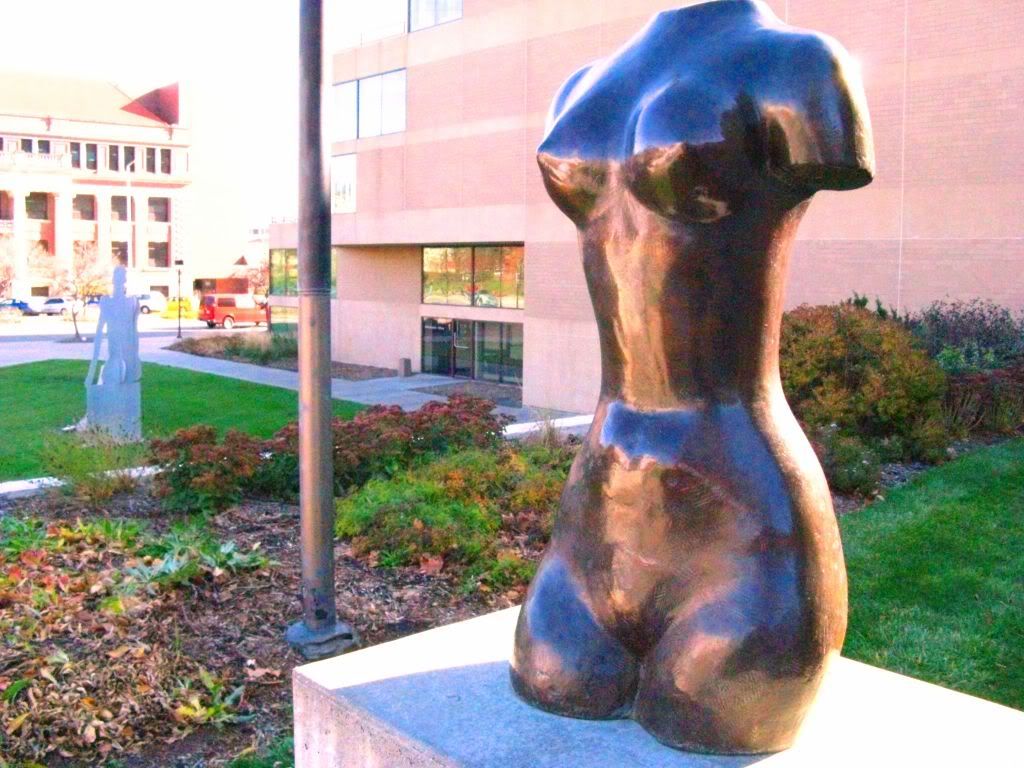
First, I feel that I need to tell you that you are not a real person. I know you feel this way since you are among the most realistic sculptures depicting human forms in this beautiful sculpture garden, but this is not the case. You are not a real person at all. You have been casted into bronze, which is nothing more than a mixture of copper and tin. Furthermore, you have no limbs. Granted there are people in this world who in fact have no arms or legs, so allow me to include the fact that you are headless as well. People have heads. You are nothing more than William Zorach’s interpretation of the torso of the female body. I am not saying this to hurt you in any way; I just need you to understand this. He did not even have the decency to interpret you as a real, full- and able-bodied woman. He stripped you of your arms and your legs and your head to make you spectacle to other people. Luckily, this torso of yours in itself is able to express to us that you are supposed to be a woman. Otherwise, we never would have known. You have no other identity. No fingerprints or footprints to distinguish yourself from the next criminal, no face to be remembered by, no hair to play with… and thinking of all of these things you have been deprived of, that I am sure most of us take for granted each day, I cannot help but feel sorry for you. Where is the individuality? All women have hips and breasts and stomachs, but it is the differences in the contours of our faces – the ways in which we smile, the texture and “flowy-ness” of our hair, the wrinkles that form around our eyes when we are happy, sad or angry – that distinguish us one from another. But… I must ask myself – how many women do I know that are built to have only torsos? Absolutely none thank goodness. (No offense!) So perhaps the fact that you have none of those distinguishing features is actually what works in your case to distinguish you, Torso, from the rest of us. This major difference, these major absences, force us to focus on an area of the body that we probably would not otherwise focus on when trying to find meaning behind a work of art.

Honing in on this, the only part of your body that was left after Zorach’s mutilation (if it is even a mutilation), I was able to decipher for myself your entire childhood, adolescence, and future. As for your childhood, you grew up with only one parent, one creator. This person is William Zorach. He formed you initially from the rougher Labrador Granite, then later made the decision to cast your form into the more sophisticated and durable material of bronze, leading you into your teenage years. This is around the time when onlookers began to notice the uniqueness that is your body shape. This is the uniqueness that I have come across well into your “adulthood” as a sculpture, but I say it is better that I noticed late than never. The top half of your body is much smaller in proportion to the bottom half of it. Your waist is super small and your measurements are not realistic at all – at least in accordance with my body. Why is that? Well I know you are not able to answer, so I will give you an answer and you can just let me know if I am right or not. Again, William Zorach is manipulating the female body. He is the creator, so he has exploited it to his preferences and his perceptions. This man has literally constructed a woman to his liking, and you are her. As for your future, you will continue to be put on display, aging gracefully and being observed and picked apart by many students and other spectators. According to my research, I’ve discovered that bronze, when exposed to moisture over long periods of time, needs to be maintained by cleaning and waxing regularly to ward off any damaging moisture. So you will be able to undergo this primping and pampering for the rest of your existence here at the Sheldon Sculpture Garden. Ironic, is it not? After initially being manipulated and exploited as a woman by your creator in the past, your future will consist of being prudently cared for and appreciated. Every woman’s dream…


Well, Torso, thank you so much for becoming a part of the Sheldon Sculpture Garden here at the University. I knew I wanted to write about and get to know you as a sculpture as soon as I saw your gleaming “bronze-ness” on that bright and sunny spring day. Hopefully you will be able to help me answer some of the questions I have comprised for you in this letter, and hopefully you appreciate some of the observations and emotions I have expressed for you – not only as a sculpture, but as a representation of the female body. I am very pleased that this representation is a respectable one, in that it is not risqué in any manner. However, as I have mentioned previously, I am bothered that you have been manipulated in this way, but this manipulation is what has made you what you are – and differentiated you from the other sculptures in this garden and in history.

Thank you so much for your time, Torso!
Talk to you later,

Nina

Thursday, April 15, 2010

WP3: Pre-Writing Assignment 3


There are many different aspects of this sculpture – Torso, by William Zorach– to take into consideration when attempting to analyze it, its effect on its viewer and the possible arguments it makes. The first aspect I would like to further address is the material from which it is constructed.

Torso, though originally created from a rougher stone material called Labrador Granite (see previous blog post), the sculpture that is now on display in the UNL Sheldon Sculpture Garden was constructed using the beautiful and popular metal alloy, bronze. The question as to why this was specifically chosen for this piece is not normally among the first questions that come to mind when considering the meaning and the emotion behind the sculpture, but it is very important in its all-around and complete (or near-complete) comprehension. Since speaking of the material that makes up the sculpture falls into the category of the construction of the piece, we will now refer to this choice and utilization as an appeal to logos. Bronze is called a “metal alloy” because it is not a natural metal at all. It is actually a mixture of various amounts of the natural metals copper and tin. It is known to be a very durable material, especially when properly taken care of.

For over 3,000 years, bronze has been used in various human inventions, including various weapons, tools, coins, bells, piping, and more. Bronze was used in these different inventions mainly as a result of its characteristics of strength and durability. This is also most likely the reason why bronze was used in the construction of Zorach’s Torso. To create an even more durable material, phosphorous is also added – especially to harden bronze for machine parts and tubing. Lead is used to prepare the bronze for casting, which was the way Torso was created.

When bringing all of this information together, it is much easier to understand the reason why bronze was used in the construction of this art-object. By using this material, the sculpture is able to withstand the intense weather conditions it undergoes – especially in the winters – being located in Lincoln, Nebraska. Furthermore, perhaps Zorach wanted this strong material to represent the strength that he sees in women. Though it is not the original material used in this sculpture, its selection plays a large role in the way we see it today, and all of these things help to support the appeal to logos we find in this particular sculpture.

Saturday, April 10, 2010

WP3: Pre-Writing Assignment 2

Torso, a bronze sculpture of the isolated torso of a woman’s body, was created in 1932 by the Lithuanian William Zorach.

Though this art-object that can be found in the UNL Sheldon Sculpture Garden is clearly made of bronze, Zorach’s original Torso was actually made using a material called Labrador Granite and later cast in its current bronze. This strong, stone material and the work he created within it was selected by Zorach, thus giving the audience of this art-object some idea as to who he might be as an artist, and possibly even as a person. This appeal to ethos, though obvious, gives the audience a clearer insight as to what aspects of this piece should be focused on and further analyzed. Labrador Granite is known for being extremely difficult to carve. This presents to the audience the idea that perhaps Zorach was up for a challenge in creating his version of the smooth and curvaceous figure of a woman through this difficult stone material. Furthermore, the fact that William Zorach chose to use Labrador Granite in the interpretation of the female form is a conundrum in and of itself. In art-objects that are more ancient that representing the female body, smoother materials such as marble, limestone, or some metals were utilized to make for an easier carve and a more true-to-life end product. Zorach’s selection is both unusual and telling of his persona as an artiste.

Moving on from speaking of Zorach’s intent, the current presentation of Torso in the Sheldon Sculpture Garden appeals to pathos through elements such as color and vectors of attention. As mentioned above, the sculpture is made of bronze. The color of this metal on Torso is mostly a deep brown, with some – not many – lighter and darker spots. This color, to me, gives off a different aesthetic than would silver, white, black, or any other. It seems more warm and welcoming. This feeling is also brought about by the small bits of discoloration on the sculpture. This deep brown color, though, automatically provokes within the audience the question, “Why?” I have not the answer to this question, but I do have my own feelings and interpretations. I see it as this is the way the presenters wanted women to be represented. Perhaps this color along with other aspects of the sculpture is used to present to the audience what the creator(s) might admire most in women, or the way they feel women should be represented through this particular piece. Sure this may be a stretch, but in my past experiences, I have learned that once an artist presents his completed work, it is open to any criticism or interpretation by its audience. The color of this sculpture is what provokes this aesthetic and these feelings, thus exhibiting to its audience an appeal to pathos. In addition to the element of color, vectors of attention are apparent in this work as well and also evoke emotion within the viewer. The “woman” is facing head-on, unafraid of coming obstacles and standing up straight, looking forward to the future and whatever may come her way. This created a feeling of pride within myself as a young woman viewing the work.

Thursday, April 8, 2010

WP3: Pre-Writing Assignment 2


As far as my previous experience with art objects goes, I have very little. Most of my art object experience stems from my elementary and middle school art classes. Many of the assignments we were given, however, fell under the more “advanced” categories of pottery and sculpting. My art teachers generally tried to avoid delving us as students into abstract art. This is perhaps due to the fact that they felt that we would be unable to grasp the concept of it all. As a result, the majority of our art assignments involved everyday objects and still-life work. Generally, our created pieces were finished with glaze, so I do have some experience in that area as well when it comes to pottery. Although my past experience with art objects is rather limited, I feel that it will help me in many ways with this next writing project. For instance, in addition to creating sculptures in my art classes, we would also analyze and interpret works of art selected by our teacher. We would try to decipher our own meanings behind these works of art and often times create our own interpretations of them. I find this very helpful now even though the medium they would expose to us would be mainly paintings. This deciphering of the different meanings and emotions behind the works of art we would be assigned in class, and the analyzing and dissembling of such works has allowed me to more easily create in my mind both a visual picture and a verbal argument through which I would be able to interpret the work. Overall, I believe I would do well writing a rhetorical analysis on a sculpture I chose from the Sheldon Garden because of the experience I have had with art objects, but I am sure this will not stimulate me at all in the realm of creativity.

Monday, April 5, 2010

WP2: Final Draft

Author's Note:

In hopes of breaking the tedium of reading and writing essays in the form of blog posts, I decided to choose the alternative option for this project and create my own comic. My comic is entitled “The Palovican Box of Love,” and it consists of seventeen panels. When working with the other students who opted for the alternative project, I quickly realized that my comic was much lengthier than theirs were. One was as short as three panels long, and the longest was no more than twelve. Rethinking the layout of my comic, and not wanting its length to be a disadvantage for me in its critique by my audience, I went back to my storyboard and looked to see if there were any panels I could edit or get rid of to compress my story and to possibly make it easier for the reader to understand. I was able to get rid of one panel completely and consolidate two others, but this resulted in the ironic addition of two new panels – panels 3 and 4. These two panels were added to visually illustrate where this family is headed and how greatly the image of this foreign country contrasts with the image of the “Big City” to which they have all grown accustomed.

Another aspect of “The Palovican Box of Love” that I incorporated in order to express the physical difference between the people of Palovica and the American family is the use of flowers. In this country I fabricated, flowers are found everywhere – on clothing and bedspreads, in picture frames, and in other decorations. Because of this, the viewer is easily able to distinguish the American teenager from his Palovican cousins, making it much easier to follow along with the story.

One characteristic I wanted my comic to have is relatability. I wanted my comic characters in the younger generation to be able to easily relate to the feelings and mindset of the people in my audience. In order to accomplish this task, I used simple and cartoon-like representations of people in my comic and dialogue and captioning that I have either used myself or heard before in conversations that have been within earshot range of me. In addition, I feel that the captions that have been placed on almost every panel contribute to this feeling of relatability. The audience is able to tune in to the inner thoughts of the American teen, who is the main character, and either agree or disagree with what he is saying. The use of captioning in this comic also works to further inform the reader. If he is not able to comprehend some aspect of the story, the unspoken comments of the teen help clarify.

I am pleased with the final layout of my comic and feel that all of the panels in “The Palovican Box of Love” are necessary and relevant to my story.


Links:

Statement of Purpose


Final Draft:

Panel 1, Panel 2
Panel 3, Panel 4
Panel 5, Panel 6
Panel 7, Panel 8
Panel 9, Panel 10
Panel 11, Panel 12
Panel 13, Panel 14
Panel 15, Panel 16
Panel 17, Panel 18